| Gardner’s Beacon TM is published by the Thomas Gardner Society, Inc. (TGSoc.org). |
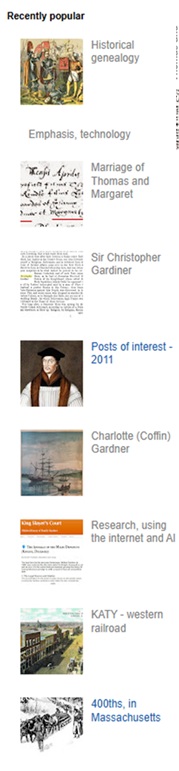
Our busy year has covered several areas which work can be followed through the blog. Two themes bearing the most attention relate to events of the 250th / 400ths commemorations and to our interest in technology. This can be seen by this report via images of read count of our blog’s popular posts.
| Those images are shown on the right of the blog post with content for “All time, popular”; “Recently popular”; and “Last week”. The below image shows icons for a list of the “Recently popular” posts: 2023 and 2024.The most popular of these posts is from 2010 on the Battle of Bosworth. The 2nd most popular is from 2014 and reports our findings on the Marriage of Thomas and Margaret. |
Past focus
We continue our support for the Heritage Society Community with a major focus being the 250th of the Declaration of Independence. Of late, D.A.R. has participated in the annual spring event of meetings in D.C. The real focus started this year with the 250th of the conflict at Lexington and Concord followed by the look back at the of Siege of Boston which is associated with the battle at Bunker Hill.
Earlier this year, we featured Mary Gardner Boylston which allowed us to consider the 400th and the 250th through related families.
Another example post is one that we did on Col. Knox’s delivery of several cannons and other equipment from Fort Ticonderoga. In 1775, he made progress in December but did not get back to Boston with the equipment until early March of 1776. His successful venture led to the British evacuating Boston.
Along that same line, we got acquainted with General Nathanael Greene this year. His appointment by General Washington as lead of the Army was later in the War. Gen Grene was the one who cornered Cornwallis in Virginia and forced a British surrender. This feat was within the first year of his appointment.
Present focus
Since the Revolutionary War went until 1783, we will be reviewing matters as we continue the commemoration until 2033. For instance, we can trace families and their history through the beginning of the U.S. and through the many conflicts over the two-hundred-and-fifty years. Too, the U.S. was principally of the east coast with some incursion into the interior. Ohio was one of the areas in the western regions at the time. In the south, Tennessee was a known entity. Within a couple of decades in the 1800s, there was U.S. presence across the interior (sparsely) and on the west coast.
An example is Bunker Hill West that is a neighborhood in Downtown Los Angeles that had a heavy New England influence. It is of interest due to the changes in the area from the 1830s until the presence of skyscrapers in the latter part of the 1900s.
Back to General Greene, we were surprised that publication of his papers was not started until 1975 when the 200th happened. Six volumes were published in short order. Over the next few decades, the research on the General filled in knowledge of his accomplishments. The result? Seven more volumes. We were able to use these publications for lineage research and expect to learn from them about the last years of the Revolutionary War.
Future focus
One thing expected with these two lookbacks is that research will be different and produce lots of data that will be usable for further analysis. There was not much review of the colonial period (the 400th) until after the Civil War.
One sees lots of interest now in both genealogy and family history where details not available before can become useful. A case in point is David T. Gardner’s work on his family’s involvement with the culmination of War of the Roses. David researched for decades slowly bringing information to light. This year, using the facilities of newer algorithms has been remarkable. With his work, we can pay attention to both the boon and the bane. This work will be reported regularly.
Technology
Technology will have both a positive and negative influence on types of activity that are of interest to us. But, concerns about technology from the viewpoint of the U.S. and its leadership roles in the world will also important.
| Gardner’s Beacon TM is published by the Thomas Gardner Society, Inc. (TGSoc.org). |
Source: Gardner’s Beacon, Vol XV, No 1
Sponsor: Thomas Gardner Society, Inc.